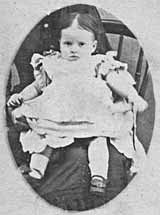
The 25-year-old Englishman Francis Herbert Dufty (named after his father, also a photographer) arrived in Levuka from the Colony of Victoria in early 1871, where he had conducted a successful travelling photographic business (the No. 3 Branch Expedition Portrait Company) with his younger brother Edward for the previous six years. He set up a new studio next door to Fiji Times office on May 24 1871. He was joined there by his brother Alfred in December of that year, but as Alfred was only 16 at the time, and was out of Fiji in Australia and New Caledonia for extended periods of time, it is clear that most of the photographs and the initiative for the studio were Frank's.
It should be acknowledged that his was not the first photographic studio to be set up in Levuka: a couple of visiting photographers had passed through in 1869 and worked there briefly, and A.S. (Abraham Solomon) Levinski had opened his new studio on April 26 1871, just one month before Frank Dufty opened his doors. Levinski was apparently unable to withstand the competition offered by the Dufty studio, and soon dropped out of the trade, though continuing to live on in Levuka [Fiji Times research by Mark & Geoff Hamilton, pers.comm.Feb 2008].
During the sixteen years that followed its setting up, the Dufty studio in Levuka prospered, and their premises were substantially extended. They produced studio portraits, landscape photographs and a large body of "cartes de visite", which had been popularised in Europe in the mid-19th Century. They photographed missionaries, European settlers, the Fijian hierarchy that naturally gravitated to this centre of power, and even the mountaineers or Kai Colo. This last group presented the most stubborn resistance to Christianisation, and to first Cakobau's government, and then to the British Colonial Government following Cession in 1874.
While the cumbersome wet-plate technology of the day meant that many of these photographs were studio setups, they nonetheless comprise a fascinating document of the time when probably the most dramatic changes in the history of Fiji were occurring. The "ethnographic" photographs used a range of "props" that he assembled for the purpose, so one finds the same weapons and body-ornaments recurring with different bearers or wearers. However, the ridiculous combinations of gear found in later photographs are absent here - the "genuine article" was still visible all around, and there was no reason to diverge from authenticity. Later, ignorance was to combine with the layers of myth and fantasy that had developed, and during the first half of the Twentieth Century many outlandish confections masqueraded as ethnographic photographs. The Dufty pictures are, therefore, of great value.
The capital of Fiji was removed from Levuka to Suva in 1882, and Alfred Dufty transferred to Suva in 1884 or 5 (presumably to "test the water"). Though the enterprise in Suva started ambitiously, competition from other photographers was now far greater and more consistent, and feeling that there was insufficient work to support two families, Alfred and his family left to return to Australia just as Frank moved to Suva in June 1887. Frank did not remain there long either, and left Fiji for Melbourne in April 1892.
Mrs Joy Fegent of Sydney, granddaughter of Alfred, has provided me with the following postscript to their Fiji careers: Unfortunately, Frank was apparently unable to repeat his Fiji success. He did not work as a photographer in Melbourne, and died there in 1910 at the age of 64. Alfred had a newsagent and stationery shop in Melbourne for a few years, during which time he acted as agent for several Fijian businesses. He subsequently removed to Sydney with his large family (six sons), and in 1906 resumed his career as a photographer, setting up a Marine Photography Studio in Erskine Street that he ran very successfully for the next twenty years until the year of his death at the age of 68, 1924. His son Roy took over the business on his father's retirement and ran it for a further five years.
The small selection from Dufty's oeuvre depicted here are in my own collection. For the generous gift of most of these I am deeply indebted to Virginia Marlow, daughter of another pre-eminent photographic chronicler of Fiji and Fijians, and a personal friend of my family, Rob Wright. These pictures originally formed part of his personal collection. Some of them were reproduced in my book "Fijian Artefacts: the Tasmanian Museum and Art Gallery Collection", Hobart, TMAG, 1982, and the revised and expanded "Traditional Fijian Artefacts", Nubeena, Just Pacific, 2014.
I have provided brief descriptive notes, but have not attempted a detailed analysis of the historical/anthropological importance of the photographs. This has been undertaken by others, notably Brigitte d'Ozouville in two very useful papers in 1997: "F.H.Dufty in Fiji, 1871-1892. The social role of a colonial photographer." History of Photography 21(1):32-42, and "Reading photographs in colonial history: a case study from Fiji, 1872." Pacific Studies 20(4): 51-76. There are brief biographies of the Dufty brothers in The Cyclopedia of Fiji (1907, reprinted Fiji Museum 1984), on pages 222 and 266.
Several images by the Duftys that are not illustrated here can be seen on the Fiji Museum Online's Glass Plate Negatives Virtual Exhibition. Also, a group of cartes de visite from the John Etkins Collection in the State Library of Victoria are reproduced on http://www.pictureaustralia.com/ (go to Advanced Search, and type Dufty into the Photos By panel). There is also a major piece by Frank Dufty, a composite photo montage of Levuka along with many of his portraits of Fijian notables, in the Australian National Library collection, online at http://www.nla.gov.au/apps/cdview?pi=nla.pic-an10975065-13
© Aug 2008, Roderick Ewins
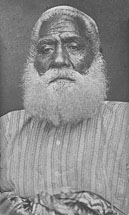 Ratu Seru Cakobau, Vuniivalu of Bau, Tui Viti, at about the time he and a group of other powerful chiefs ceded Fiji to Britain in 1874. |
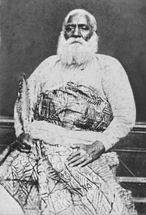 Ratu Seru Cakobau wears a copious, red-brown Tongan ngatu. In Fiji this cloth is associated with chiefs and sacred uses. He catches it with a white barkcloth cummerbund (i-oro) and holds another chiefly symbol, a fan (iri), in this case feather-trimmed (vakavuti). |
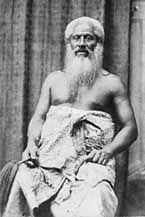 Unidentified chief wearing loose barkcloth, skirt i-sulu, and holding the chiefly symbol flywhisk (i-roi). |
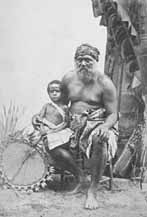 Unidentified chief with child. Elder wears barkcloth, chiefly smoked headscarf (i-sala) and loose skirt i-sulu, and holds a chief's iri masei fan |
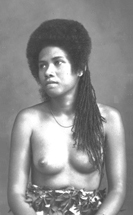 Unidentified young woman wearing tobe "virgin plaits", today only found in a couple of islands of the Lau Group. These plaits would have been cut off by her husband at the time of her wedding. |
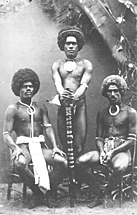 "Big head" mountain men (kai colo), probably from Namosi, wearing the huge wigs of human hair (ulumate) for which they were famous. These warriors were justifiaby feared by their coastal neighbours, who retaliated by stigmatising their name to mean "bushwhackers". The men pictured here wear only malo loincloths. The seated men wear pigs' tusks (bati ni vuaka). The standing man wears a civa pearl-shell and holds a rootstock club with a fibre-bound handle (waka vividrasa). (See Ewins 1982 pp.34-36) |
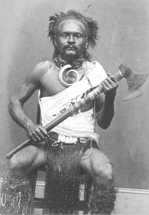 Warrior (qaqa) with a battleaxe (i-teba). He wears his i-oro cummerbund high, sign of challenge, has a wabale sash. His skirt (liku) and vesa leg flounces are of black vine (waloa). His warrior status emphasised with a fine boar's tusk (bati ni vuaka). (See Ewins 1982 pp.25, 47). |
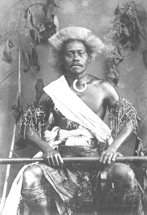 Warrior (qaqa) with a straight pole club (gadi). He wears his i-oro cummerbund high, sign of challenge, has a wabale sash. His skirt (liku) and vesa leg flounces are of black vine (waloa).His warrior status emphasised with a fine boar's tusk (bati ni vuaka). (See Ewins 1982 pp.25, 47). He appears to be wearing a two-toned wig. |
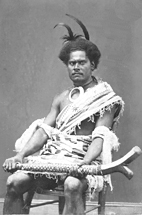 Warrior (qaqa) wearing much barkcloth: a skirt (i-sulu), i-oro cummerbund, wabale sash and vesa arm flounces. His warrior status emphasised with a native cock feather (vuti ni toa tagane) and boar's tusk (bati ni vuaka). He holds a kiakavo footsoldier's "standard" club. |
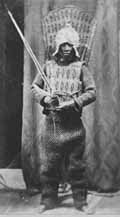 Native of Gilbert Islands (now Kiribati) wearing traditional armour [shirt and trousers woven from coconut twine (sinnet), a front- and back-shield, and puffer-fish helmet] and holding a sharks'-tooth sword. |
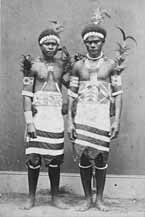
|
|
|
Photo of European settlers' child. No provenance or indication of the baby's identity, or if it is a boy or girl (they were dressed the same in those days), but the card back (see next pic) states it was taken in Levuka, not Suva, so it dates from between 1871 and 1884. |
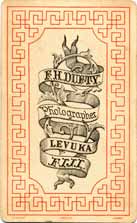 The back of the carte-de-visite of a baby, in the last frame. This particular card was printed in France (label reads Marion Deposé). then the face albumen-coated with egg-white and chemically light-sensitised by Dufty prior to exposure to the glass-plate negative. |
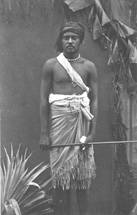 Ratu Timoci Tavanavanau, second of three sons of Cakobau by Adi Litia, He wears a chiefly red-brown smoked barkcloth headscarf (i-sala kuvui) and wabale shoulder-sash, and a masi barkcloth cummerbund (i-oro), but his i-sulu skirt seems to be a tasselled Western cloth, perhaps a counterpane. Ratu Timoci and his manservant were the ones who introduced the measles to Fiji from NSW, starting (but surviviing) the epidemic that wiped out a fifth of the Fijian polulation. |
|
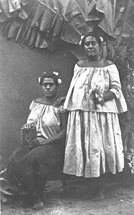 Two daughters of Cakobau and Adi Litia, wearing smocks and skirts. Adi Kakua is the one on the left holding an elaborately bound book (presumably a bible) whilile her older sister Adi Arieta Kuila (d.27.1.1881) is standing, holding a posy of flowers. |
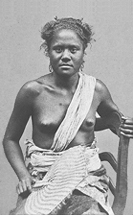 Unidentified young woman wearing masi barkcloth and holding i-iri buli fan. From her featires and hair she may have been one of the mixed-race daughters of a settler. |
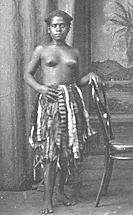 Unidentified girl wearing a dance skirt of dyed and pleated strips of vau bark (Hibiscus tileaceus). |
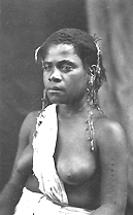 Unidentified young woman wearing white masi barkcloth sash (wabale) and skirt (isulu) elaborate hair andear ornaments. |
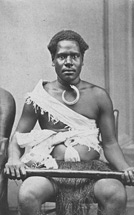
Warrior (qaqa) with a straight pole club (gadi). He wears his i-oro cummerbund high, sign of challenge, has a wabale sash. His skirt (liku) is of black vine (waloa), his warrior status emphasised with a fine boar's tusk (bati ni vuaka). (See Ewins 1982 pp.25, 47).
|
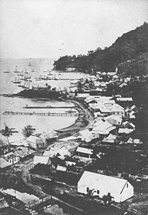 Levuka township, at that time the capital of Fiji, Ovalau Island. Taken from "Gun Rock", north of the town. Mission Hill rises on the right in the centre of the picture. |
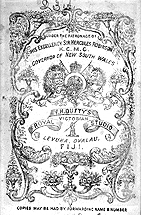 Back of the cards, which reads: UNDER THE PATRONAGE OF HIS EXCELLENCY SIR HERCULES ROBINSON KCMG GOVERNOR OF NEW SOUTH WALES F.H.DUFTY'S ROYAL VICTORIAN STUDIO LEVUKA, OVALAU, FIJI ...COPIES MAY BE HAD BY FORWARDING NAME AND NUMBER. The invoking of Sir Hercules' name (with permission, I wonder?) dates this as having been printed during the period of his interim stewardship of Fiji following Cession in 1874 and before the 1875 arrival of the permanent Governor, Sir Arthur Gordon. |