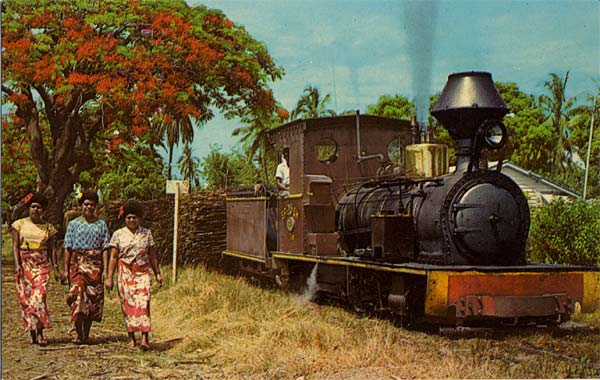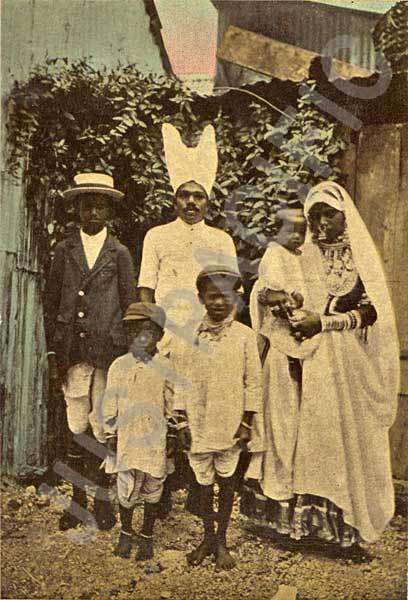
"Indian settlers in Fiji".
Unused, undated. Published by Arnold and Co., Suva. Divided back hand-coloured real photo postcard, probably pre-1910.
The family assembled in their best clothes for the photograph. All of the children and their father wear dhoti as their lower garments. The father's turban is quite remarkable, I have never seen one with two peaks like this. If any viewer has any information about this style, I would be pleased to hear.
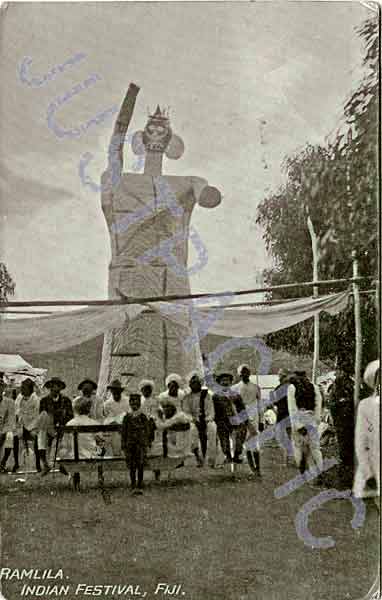
"Ramlila Indian festival, Fiji".
Unused, undated. No publisher or photographer indicated. Divided back postcard, but probably pre-1910.
Ramlila festivals are held by Indians worldwide in the month of October. The central activity is a play documenting the life of the Lord Ram as recoounted in the Ramayana. Each episode is called a "lila". The festivals can take from several days to nearly a month in different places. A story of good and evil, it culminates in the battle between Lord Ram and the demon king Ravan, who is invariably depicted by huge idols such as the one in this photograph. The battle was precipitated by Ravan abducting Ram's wife Sita. Rama, suported by his brother Lakshman and by Hanuman and his army of monkeys, fought Ravan for ten days and finally killed him.
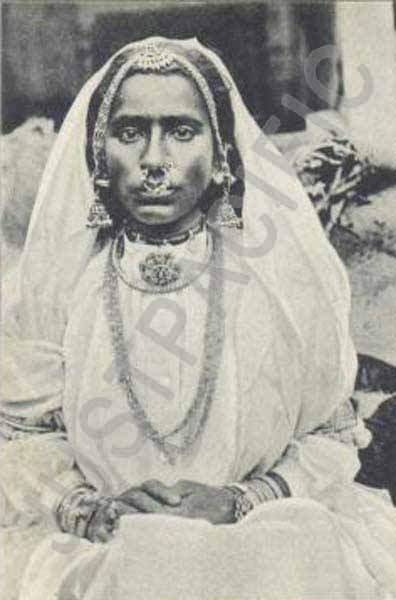
"An Indian immigrant, Fiji".
Unused, undated. Undivided back*, probably pre-1906.
This woman is dressed in all her finery, her gold jewellery prominent. Even by the time of my childhood in the 1940s, such a display would normally be seen only on the occasion of a bride's wedding, though during that decade it was still common to see women on visits to town wearing quite a lot of jewellery, and nose-rings such as this woman's were commonplace. By the 1950s neither of these things was so common, and they diminished progressively. There is no indication of where this photo was taken, but my guess would be that this young woman had come out from India to be married, in an arranged marriage. Whether she was photographed at her wedding, or on the occasion of first meeting her prospective family after her time in quarantine on Nukulau, would be anyone's guess.
* Stephenson published a version of this card with a divided back, hence post-1906. Apparently it continued to be published for some years.
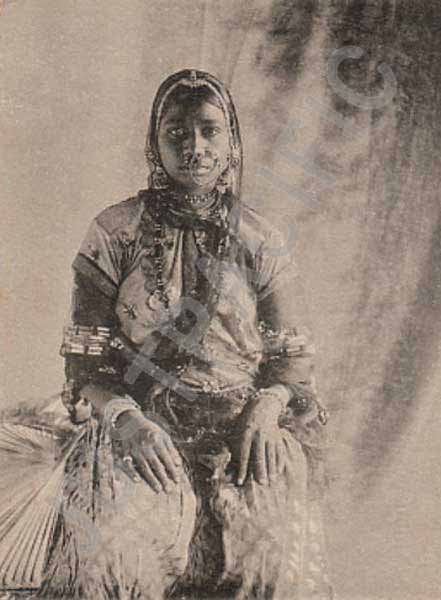
"Young Indian woman, Fiji".
Unused, undated. Undivided back., probably pre-1906.
Like the previous picture, this woman is dressed in all her finery, her gold jewellery prominent. She is wearing a short-sleeved kurti over a longer-sleeved blouse, and a full skirt.
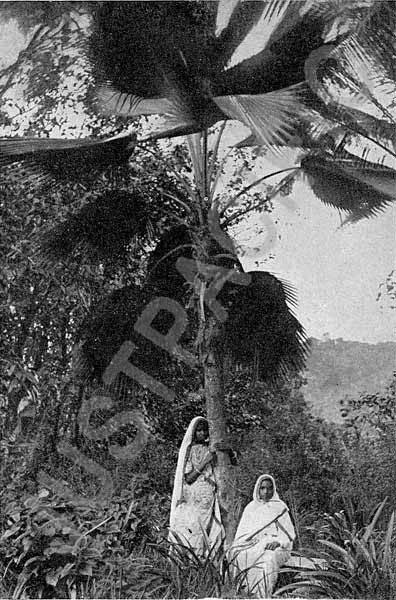
"Young women of the Indian colony of the Fiji Islands" (Jeunes filles de la Colonie indienne des Iles Fidji".
Unused, undated, but probably about 1920. From a series produced by the Marist Brothers Missions in Oceania (Missions des Pères Maristes en Océanie). Published by Sous-Procure des Missions, 9, Rue de Bagneux, Paris-VI
These young women are dressed in normal clothes of the period. They are under a fan-palm, niu masei (Pritchardia pacifica).
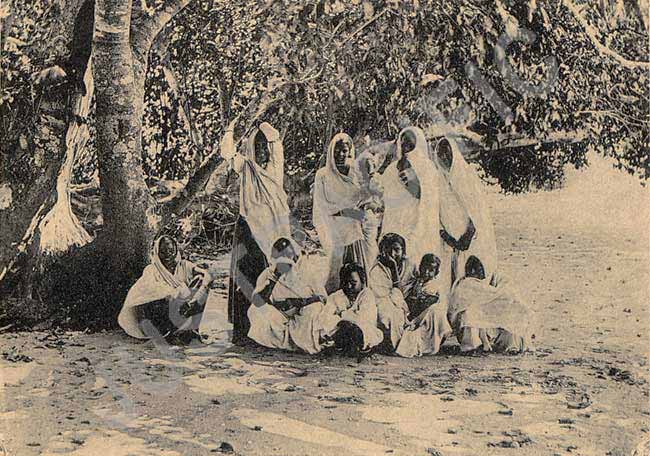
"Indians on Beach, Suva". Published by A.M. Brodziak & Co., Suva, Fiji.
Unused, undated. Undivided back., probably pre-1906.
The only real beach in Suva is at Suva Point, where this photo was almost certainly taken. It remains a favourite weekend outing spot for people of all ethnicities, and this group of Indian women were in all probability there for a day's outing.
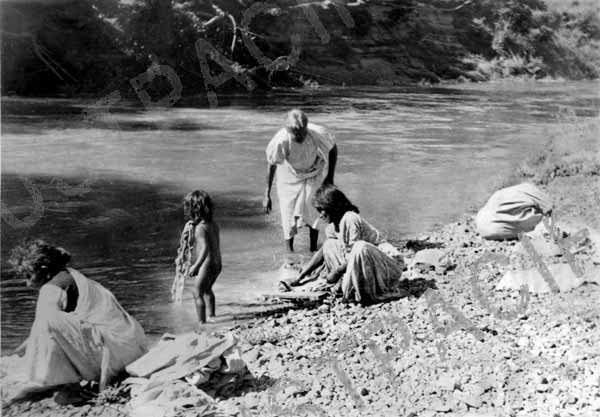
Washing day on the riverbank.
Original photograph. The name of the photographer is unknown but this was part of a group of photographs taken by an American GI when he was stationed in Fiji during WW2. It was a very familiar sight in Fiji throughout the 1940s and considerably later, as I can testify.
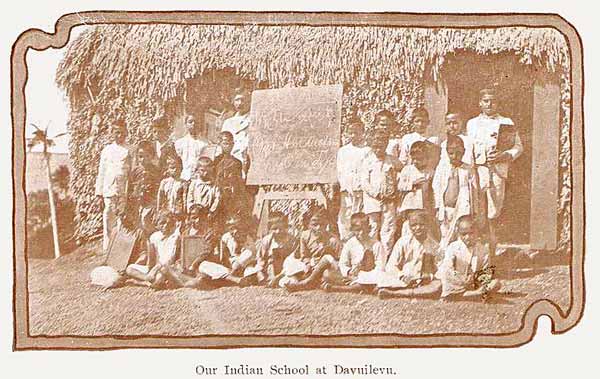
"Our Indian School at Davuilevu" (The blackboard actually says Hindustani School). Fiji Methodist Mission.
This Methodist Mission school was initially started as an adjunct to the Davuilevu School, on the Suva side of the Rewa Bridge at Nausori. As is obvious in the photograph, it was initially tiny and a boys-only school for Indian boys. It was later to grow considerably and become "Dilkusha", perhaps named after the wonderful 18th Century Dilkusha Kothi in Lucknow). It subsequently split into Dilkusha Boys School and Dilkusha Girls School, which have both also become multi-racial, but remain firmly Methodist church-based. In 2006 Dilkusha Girls School held Centenary celebrations. A personal reminiscence is Professor Vijay C. Mishra's chapter "Dilkusha", in Brij Lal ed. Bittersweet: An Indo-Fijian Experience. Canberra: Pandanus Books, 2004: 141-162
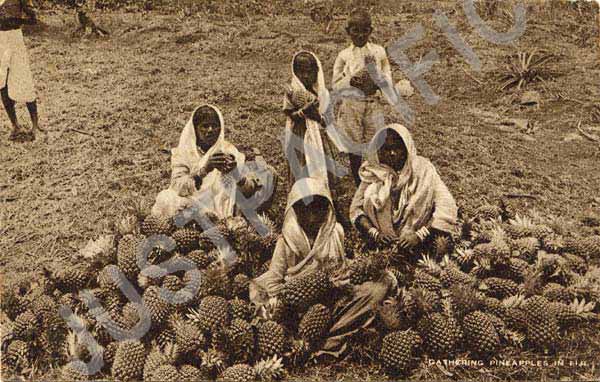
"Gathering Pineapples in Fiji" (They are actually, of course, sorting not gathering).Raphael Tuck & Sons, London.
Copyright Fiji Government, Printed in England, Used, dated.July 5, 1924. Addressed to Mrs Crook, Enfield, St George Rd., Worthing, Sussex.
Sub-caption on the back reads "In Fiji there are 60,000 indians, who were introduced as labour and have made their homes in the Colony. " There is no indication of where this was taken, but it may well have been in Lautoka, where the CSR Company grew the hybrid "Fiji King" pineapples shown here, bred for having less invasive "eyes" on the skin. The plantation, near the CSR Staff compound, was known as "Pineapple Hill". These women and the little girl are dressed in the manner that was typical right through into the 1950s, and may still be seen among rural Indian women. The man in the background, left, is wearing the loose skirt that was also very common, often caught up between the legs as a dhoti loincloth.
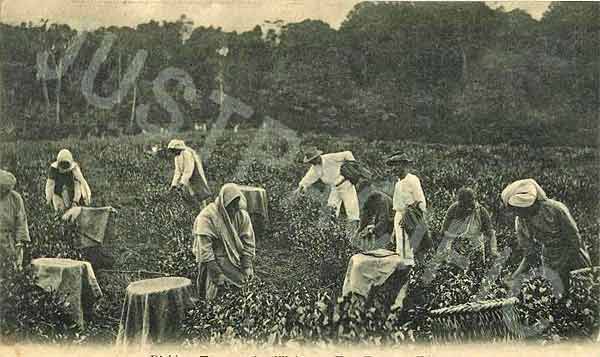
"Picking tea on the Vainunu Tea Estate, Fiji"
Published by Robbie & Company, General Merchants, Levuka, Fiji. Printed in Italy, Stab. Deutsche Erfindungen, Milano.
This card is unused and undated, but has a divided back so is probably shortly after 1906.
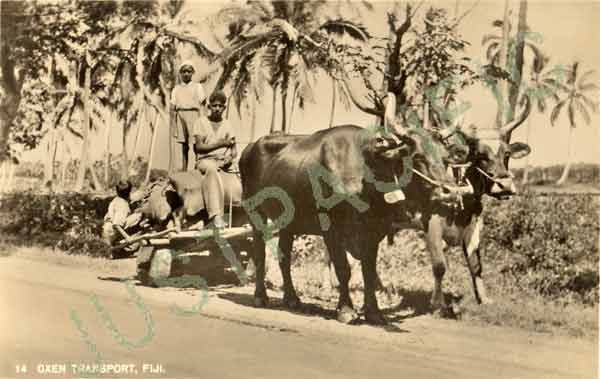
"Oxen transport, Fiji"
Unused and undated. Numbered on face, "14". Divided back, probably pre-World War 2.
These two-wheeled bullock-drawn gari wagons were still fairly common in the countryside during my childhood in the 1940s but less and less so by the 1950s. They were very useful vehicles, and far preferable to the gasita, or sleds generally made of moderate-sized forked tree-trunks often with small "deck" to transport goods. These were also towed behind bullocks but did terrible damage to roads and tracks, as well as being terribly uncomfortable and precarious to ride on (invariably standing up like a charioteer).
The working-bullocks seen here and in the next photographs were invariably zebu-cross animals, very hardy in the hot humid conditions in Fiji.
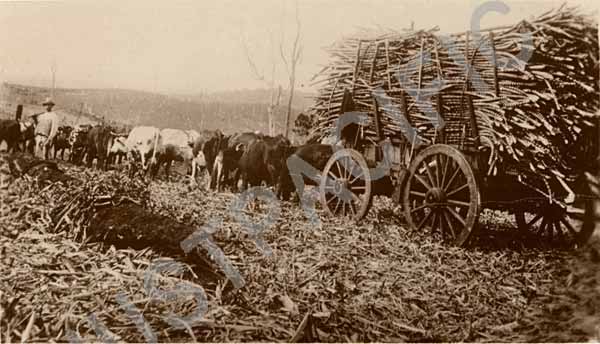
"Carting Sugar Cane, Fiji"
Unused and undated. Numbered on face, "40". On back "Guaranteed Real Photo and British Manufacture". Divided back but early card, probably pre-World War 1.
The transport of cut cane on bullock-drawn gari wagons such as this can still be seen in rare pockets in Fiji. It was unusual, however, from an early date, being superseded by the use of cane-trucks (also called gari) that ran on portable railway line that was assembled and then dis-assembled in the canefield, as can be seen in the picture two below this. These had the advantage that they could be taken to a junction with the permanent (paki) railway-line, and hooked up together to be hauled away by steam-train (see picture) to the crushing mill. When loaded onto bullock-drawn wagons the cane would either have to be taken all the way from field to mill in the cart, or unloaded and re-loaded at the railway line.
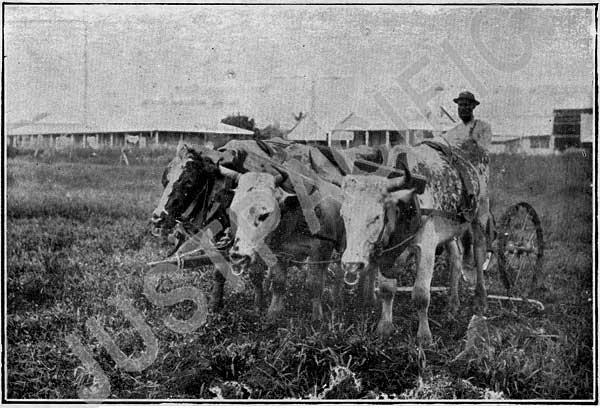
"An Indian ploughing, Fiji"
Pacific Island Series, 1 of 10. Unused and undated.
The wheels on the implement suggest it was a harrow rather than a plough. The working-bullocks seen in these photographs were invariably zebu-cross animals, very hardy in the hot humid conditions in Fiji.
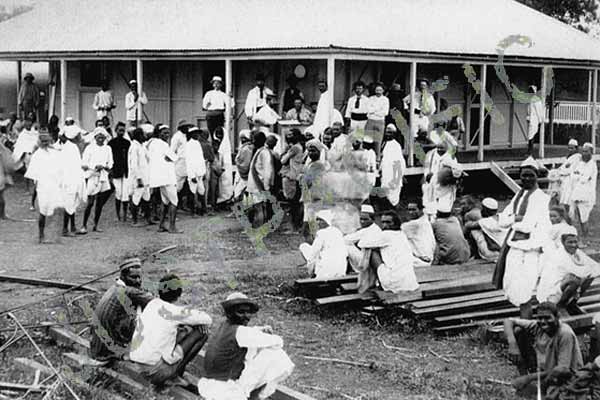
"Payday for CSR workers, Nausori, Fiji"
No publisher shown. Unused and undated, but almost certainly prior to WW1.
The Colonial Sugar Refining Company established the Nausori mill on the Rewa River in 1882. While there had been other sugar enterprises on the Rewa previously, this was wholly a CSR venture. A small subsidiary mill that was established at Viria operated for only 10 years (see Lowndes, A.G., ed. 1956. South Pacific enterprise: the Colonial Sugar Refining Company Limited. Sydney: Angus & Robertson.)
The payday such as that shown here, while logical for mill-workers and others employed near Head Office in Nausori, was impractical for workers on distant plantations, so the process was decentalised to the plantations themselves. A paymaster (generally with a "Junior" to assist) from the relevant mill office took the cash in money bags to the Estate in question, and, together with the Field Overseer of the plantation (who knew the workers), a pay station like this one would be set up, with a table in a convenient place, generally an office with an outside-opening window or a verandah such as here.
As a child growing up on the Home Estate (Manoca) in Nausori during the late 1940s and early 1950s, I witnessed many such paydays. A .38 revolver in a holster sat to hand on the table, to discourage anyone from entertaining ideas of rushing the paymasters and taking the money. The process was quiet and orderly. The F/O would call out the name of the worker, together with his father's name (Baap ke nam) since many first names were held by more than one person. The worker would come forward, be told what it was calculated he was owed, and be paid in cash. He then had to acknowledge receipt, either by signing or, if illiterate, by pressing his thumb onto an ink-pad such as used for rubber stamps, and pressing it into the appropriate spot in the paybook. Every worker would certainly have had a clear idea of what his entitlements were, and I never saw any disputes.
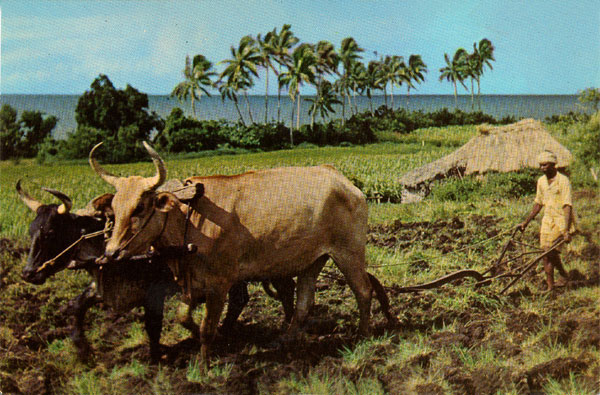
"Indian ploughman, Fiji".
1018 - Fijian Views distributed by Stinsons Ltd., Suva. Photographer: Charles Stinson 'Natural color reproduction - Curteicolor.'
Used, stamp postmarked October 1970. The caption on the back reads: 'Despite the advance of modern machinery and implements, there are still many primitive scenes such as this to be seen along the roadside in Fiji.'
From the scenery and the modified-Fijian-style thatched house, this appears to be the Ra coast, northern Vitilevu.
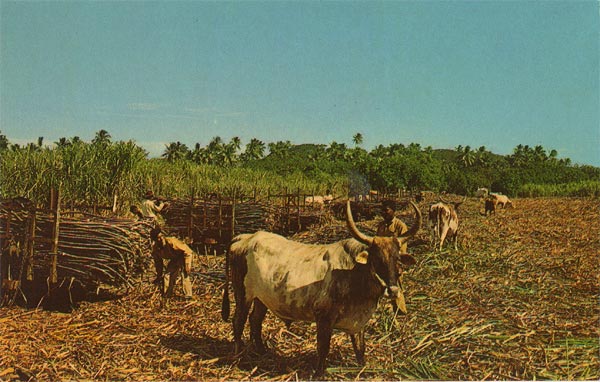
"Loading cane".
1092 - Fijian Views Distributed by Stinsons, Suva, Fiji. Ektachrome by Charles Stinson.. 'Curteicolor ® 3-D Natural Color Reproduction, Reg. U.S.Pat.Off. '
Unused and undated, but 1950s-60s. Text on back reads: 'Fijian and Indian farmers work together loading cane-trucks in freshly-cut canefields, while bullocks wnjoy eating the cut cane tops, as they wait for the next task.'
The area where Indian and Fijian cooperation such as this is most common is the hinterland of Ba, which may be where this photo was taken.
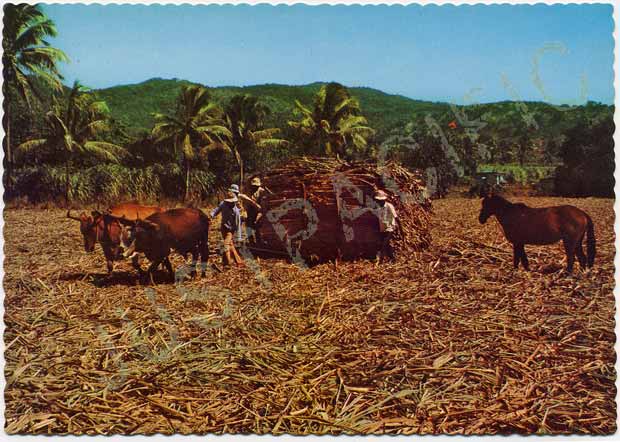
"Cane harvesting — Fiji".
Distributed by Caines Jannif Limited, Suva, Fiji.#244. Photo by Ikbal Jannif.
Unused and undated, but 1950s-60s. Text on back reads: 'Mechanised harvesting has not been introduced in Fiji yet. Bullocks and horses help farmers get sugar cane cane ready for transporting to the mill .'
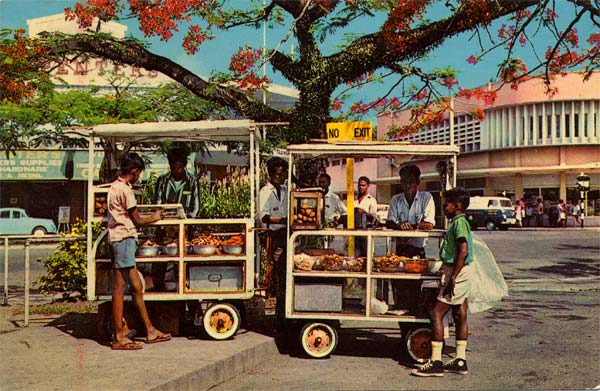
"Sweetmeat vendors".
1130 - Distributed by Stinsons Ltd., Suva, Fiji. Photographer: Charles Stinson. 'Curteicolor 3-D Natural color reproduction.'
Unused, undated, 1950s-60s.
These small trolleys selling Indian sweets (mitai) are still to be seen at various locations around Suva. These are on the corner of the Suva Market.
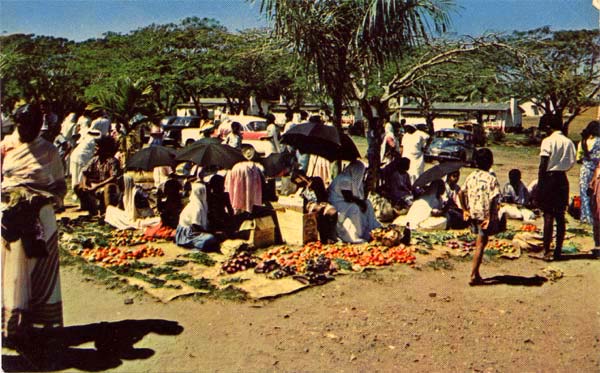
"Market day, Fiji".
A Mike Roberts Color Production, Berkeley, California 94710. Distributed by Caines Jannif Limited, , Suva, Fiji. C14235
Unused and undated, but 1950s-60s. Text on back reads: 'Conveyed by horse, boat and motor vehicle, produce from every corner of a district is brought to the market. Held regularly in the main cerntres, the open-air markets are a colourful sight."