Constance Frederica Gordon Cumming
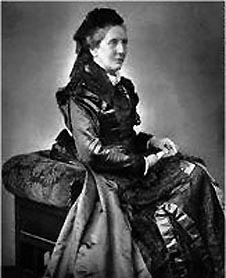
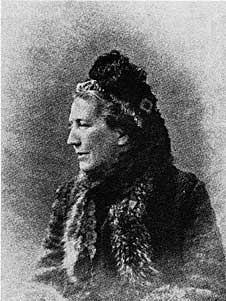
Lady Gordon-Cumming, by Herbert Rose Barrund. 1893 (National Portrait Gallery)
The pictures:
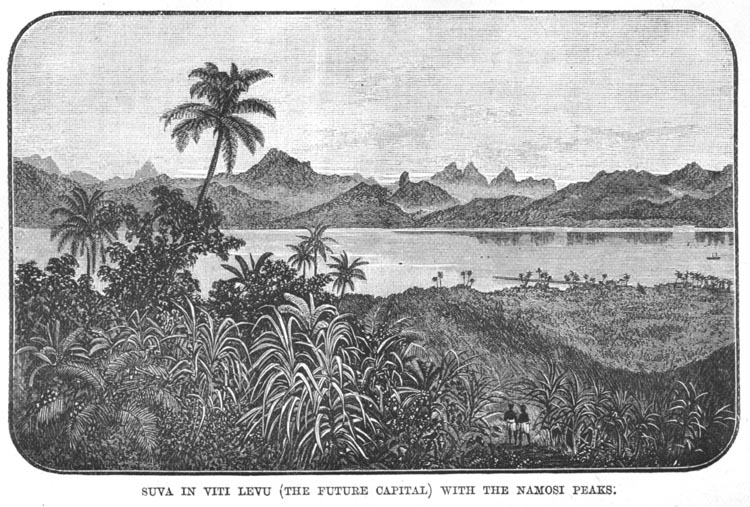
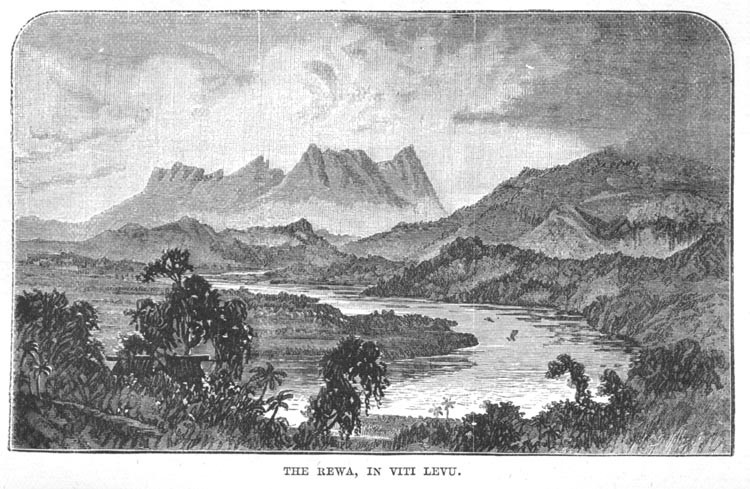
Wood engravings after several paintings, published in in her two chapters in W.C.Procter (ed) Round the Globe, Wm Isbister Ltd, London (n.d.) 188?.
Photo-relief plates reproducing several watercolour paintings in C. F. Gordon Cumming At Home in Fiji, Edinburgh, Blackwood, 1881
Brief biographical notes:
|
Constance Frederica Gordon Cumming |
|
Constance Frederica ("Eka" pron. Ee-ka) Gordon Cumming (1837-1924) was the 12th child of a wealthy Scottish family, her father Sir William Gordon Cumming (2nd Baronet), her mother Elizabeth Maria née Campbell of Islay and Shawfield. The family estates were at Altyre, where Constance was born on May 26, 1837, and Gordonstoun, now home to Gordonstoun School, which boasts some very eminent alumni, among them the Prince of Wales.1
Constance grew up in Northumberland and was educated at Fulham in London. A self-taught painter, she received some help and advice from artists visiting her home, including Sir Edwin Landseer, painter of "Stag at Bay" and Queen Victoria’s favorite painter.
She was a remarkable woman in a number of ways, not least as an accomplished artist who produced over a thousand paintings of subjects all over the world. She was a prolific author — her Pacific experiences are best remembered from her books At Home in Fiji and A lady's Cruise on a French Man-of-War. She also contributed articles to various magazines, being grouped by one author among "Viragos (sic) of the periodical press" 2 Moving in wealthy and aristocratic circles as she did, among the great number of her acquaintances was Sir Arthur Hamilton Gordon, KCMG, son of George Hamilton Gordon, the Fourth Earl of Aberdeen and Prime Minister of Great Britain 1852-55. In 1874 Sir Arthur was appointed the first permanent governor of the fledgling Crown Colony of Fiji, and because of their acquaintance, and because she was already renowned as an intrepid traveller and adventurer, Constance was invited to come to Fiji as the guest of Sir Arthur and Lady Gordon as he assumed the governorship of this strange "new" land - a role for which she was uniquely prepared. She therefore accompanied the family as a member of their travelling party as they sailed from England by way of Singapore and Torres Straits to Brisbane and Sydney, and finally to Fiji.
During those first months, the vice-regal entourage at Government House in Nasova, Ovalau was quite small. The travellers had been joined in Brisbane by Alfred Maudslay,3 who had for a time been private secretary to Sir William Cairns, the newly-installed Governor of Queensland. That had been an unhappy post, and he had been delighted to accept Sir Arthur's request that he join him in Fiji, as he was terribly short-staffed and there was so much to do. He travelled to Sydney and joined lady Gordon and party, Sir Arthur having gone on ahead. They spent a month in Sydney before sailing, during which time Maudslay accompanied "Miss Ika (sic.) Gordon Cumming" (p.75) on a painting trip to the Blue Mountains — "I never found her so agreeable as when we were for a week together in a lonely hotel in the the Blue Mountains of New South Wales" (p.86). Many years later he observed that that "She had a distinct talent for landscape on a large scale, and after the first few hours' work on the spot the pictures were admirable. [However in a letter to his sister written at the time, he placed a caveat on this statement, see below.]
"After our trip to the Blue Mountains I went with Miss Gordon Cumming to stay with the Campbells at Duntroon. This was rather the show station and was quite comfortable and civilized, and the horses they gave one to ride were well broken. While we were staying there the Campbells gave a ball. All the ladies came on horseback, and after taking off coverings, shook out their flounces and put on their dancing shoes. … One little thought at the time that Duntroon would be chosen as the site of the Capital of Australia and be now called Canberra." (p.76)
So it is clear that Maudslay and C.G.C. already knew one another quite well by the time they finally reached Fiji on the 19th September 1875, and their association inevitably continued there since they were part of a very small group at Government House. I shall include a couple more quotes from his book, since it gives some idea of the time and place, as well as of C.G.C. Writing home to his siser about a year after he and C.G.C. had first met, he described her thus:
"Miss Gordon Cumming (usually called by outsiders Miss Cummins, which annoys her) is a very tall, plain woman, a regular globe-trotter, wonderfully good-tempered, no tact, very pushing when she wants anything done, and yet one of the bestnatured creatures in the world, and when anyone is ill or wants help I believe would go any distance out of her way to help them. She is sufficiently clothed in suits of brown holland or blue serge and wears an enormous pith hat. Her 'tavi', as we say here, is to wander about the world and 'see things and paint them'. She has written a book of travels in two large volumes which have been on the table for a long time, but I have not read them. She can write fluently and well, and describes the things that she actually sees very clearly, but when she goes beyond that, and flies much higher, she fails. Her talent for water-colour drawing is a curious one. She has had very little instruction, yet no subject is too big for her; the larger and more imposing it is the better she likes it. She sketches in her outline with the most wonderful rapidity and accuracy, and when her pictures are about three parts done they are often most admirable but she persists in taking them home to finish them, and that takes away much of their merit. She had the other day two sketches taken on the Upper Rewa that I would have given her anything for, as they were when she left off sketching on the spot, but she must needs finish them at home and now they have lost their charm. I am afraid we all tease the poor woman a good deal, but then she does rise so beautifully, and besides is quite capable of taking care of herself. Missionaries are a fine bait. She travels about the country a good deal with the Missionaries, and is given to looking at things not only from their point of view, but from the ideas they have crammed her with. I believe she has written some articles for Good Words on Fiji, but they have not yet been printed. I think she is absolutely frightened to write a book on Fiji, which is a great relief.4 (pp. 84-85)
… She is off now on a trip to Windward [Lau] in the missionary schooner. She is no relation whatever to the Governor, she merely came out as a friend, and I don't think Lady G. knew much of her until they met on board ship." (p.86)
It should be mentioned that when Lady Gordon's party arrived, they found a guest ensconced at Government House, a 20-year old Baron Aloys von Hügel, who had come to Fiji via New Zealand hunting weapons etc., had been in a parlous state in the interior of Vitilevu before being discovered there and taken pity on by Arthur Gordon (a young relative of Sir Arthur whom he had brought along as Private Secretary). During his time there von Hügel amassed a large collection of Fijian artefacts of unsurpassed quality, which he took back to Britain on his return there. On being appointed inaugural Director of the new Cambridge Museum of Archaeology and Anthropology (Cambridge being his Alma Mater), presented his collection to that institution. It was later supplemented by a significant amount of material collected by Sir Arthur Gordon.
In another letter dated Sunday, 6th December 1875, Maudslay wrote home from Suva:
"We came from Levuka in our new small steamer, the Fitzroy, and our party consists of the Governor, Lady Gordon, their two small children, Miss Gordon Cumming, a nurse, a native boat's crew and a few Indian and native servants. [This is an interesting early mention of Indians already in Fiji, little over half a year after Sir Arthur's arrival.] We are lodged in what is known as the Suva Hotel! an unihabited wooden shanty with an unlined tin roof; 5 and my first work was to send our four-oared gig up the bay to cut bundles of reeds with which to cover the roof, as heat under the tin was unbearable. Suva is the the possible site of the new capital, so we were all most anxious to see it. At present there is only one house here which is owned by a white family. The view over the bay is beautiful, and there is a splendid outline of mountains on the far side." (pp.92-3). [This is the view C. G. C. painted in a particularly appealing landscape.] "We went last Thursday with the Governor to pay his first official visit to Rewa, rather a hard pull in the gig against a strong head-wind. When once we got into the river-mouth, or rather one of the river-mouths, for there are many of them, the change from the rugged mountain scenery we had become used to was most complete. Considering ghhe size of the island of Viti Levu, the Rewa [in Fijian Wailevu or 'great water'] is certainly a gigantic river; the breadth close to Rewa Town is nearly that of the Thames at Westminster. The ddelta forms a large alluvial tract, thickly populated. and I should think very productive." (pp. 95-6) [ C.G.C. conveyed something of the grandeur of the Rewa in her panoramic painting of it.]
After leaving Fiji, Constance Gordon Cumming sailed for the US via Tahiti, and in April 1878 visited Yosemite. Intending a three-day visit, she stayed three months. She wrote, “I for one have wandered far enough over the wide world to know a unique glory when I am blessed by the sight of one . . .” While in Yosemite Miss Gordon-Cumming painted a number of watercolours, which she displayed in Yosemite Valley—making it the first art exhibition in Yosemite. She published her letters from Yosemite as Granite Crags.
On another of her epic adventures, In 1879, while visiting Peking, China, Gordon-Cumming met William Hill Murray, a Scottish missionary to China. He had invented the Numeral Type system, through which blind and illiterate Chinese learned to read phonetically, by assigning numbers to each of the 408 Chinese Mandarin sounds (not characters) was assigned a number, which was encoded in Braille. Gordon-Cumming wrote a book (1899) about the system and supported the school for the rest of her life.
In old age Lady Gordon-Cumming returned home in Scotland. She died September 4, 1924, and is buried near Crieff.
It was perhaps inevitable in the extraordinarily patriarchal society of the late Victorian era that she was the object of considerable derision and contempt from a number of male flâneurs of the era, but in retrospect that fact, and their remarks, merely serve to highlight the remarkableness of her achievements. Her career is noted in a number of university courses about female adventurers and authors.
_____________________________________
1 I am indebted to Mr Alan Wills, Archivist of Gordonstoun School, Elgin, Moray, Scotland, for seeking out on my behalf several pictures, including the photographic portrait above, and an obituary newspaper article on Constance.
2 Ralph Jessop, "Viragos of the Periodical Press: Constance Gordon-Cumming, Charlotte Dempster, Margaret Oliphant, Christian Isobel Johnstone," in Douglas Gifford and Dorothy McMillan, eds., A History of Scottish Women's Writing, Edinburgh: Edinburgh University Press, 1997, 216-231.
3 Maudslay, Alfred P. 1930. Life in the Pacific fifty years ago. London: Routledge. p.7
4 In fact, of course, in 1881 she did publish At home in Fiji, as well as the chapter in Round the Globe and a couple of papers in journals. They give a wonderful account of her time in Fiji, and the circumstances under which her paintings were made. Maudslay's catty remarks about C.G.C's paintings and her writing are difficult to understand, particularly following his assessment of her kindness and even temper. I think they can only be ascribed to the sort of disapproval Victorian males felt for any women who were independent and successful in their own right, rather than as ornaments of men. Even his jocular comment that "we all tease the poor woman a good deal" gives one pause, as it suggests a level of license and familiarity that would not normally be presumed by men of that era toward women who were not members of their own family, particularly those of the undeniable social status that she had. Perhaps her alleged lack of tact was sufficiently abrasive to counter her good qualities in his assessment of her. His remarks about Lady Gordon were in marked contrast — of her he had nothing but good to say, no doubt because she fitted his stereotype of the genteel lady accompanying and supporting her husband. He wrote in particular of her "perfectly good sound sense and tact," and noted that "we have been together a great deal, and have always been the best of friends." Finally, he approvingly noted her "very great talent for drawing from model (not from life)..." [whatever that may mean](p.83-4). It sounds, though, as though he approved of this as an appropriate lady's accomplishment, rather than an inappropriate money-making career.
5 This puts me in mind of a couple of enforced stays I made in 1986 in the optimistically-named Lakeba Guest House. It fitted Maudslay's description. The bed on which I was required to try and sleep had a thin ticking mattress on a slat base from which a couple ofthe central slats had been broken out by an enthusiastic previous occupant. Finally in desparation I pried a couple of the remaining slats loose from less critical places and placed them over the gaps. They were, happily, still there when I had to use the same bed on my return from Southern Lau a month later! Not all of Fiji's "hotels" were, at least by that date, of internationalstandard!
_____________________________________
Publications:
1876 From the Hebrides to the Himalayas; a Sketch of Eighteen Months' Wanderings in Western Isles and Eastern Highlands. London: Sampson Low,
1881 "The last king of Tahiti" IN Contemporary Review, v.41, London
1881 At Home in Fiji, Edinburgh, Blackwood
1882 A lady's Cruise on a French Man-of-War, Edinburgh, Blackwood,
1882 "Gordon Ningpo and the Buddhist Temples" IN The Century Magazine
1883 Fire fountains, Edinburgh
1883 In the Hebrides [cruising in the islands of Scotland], Edinburgh
1884 "Fijian pottery" IN The Art Journal
1884 California As I Saw It: First-Person Narratives of California's Early Years. London: W. Blackwood and Sons
1884 Granite Crags [later edition: Granite crags of California], Edinburgh and London: William Blackwood and Son
1884 "New Zealand in Blooming December," IN The Century Magazine (Dec.)
1885 "The Offerings of the Dead" IN British Quarterly Review
1885 Via Cornwall to Egypt, London: Chatto & Windus
1886 & 1900 Wanderings in China (2 v.) Edinburgh & London: William Blackwood & Sons
1887 Work for the blind in China: showing how blind beggars may be transformed into useful Scripture readers Part I, London: Gilbert & Rivington, Part II, Helensburgh (1892)
1889 Notes on Ceylon, London
1889 Notes on China and its Missions (London)
1890 "Across the Yellow Sea," IN Blackwood's Magazine
1892 Two happy years in Ceylon. 2 volumes. Edinburgh & London, William Blackwood and Sons
1899 The inventor of the numeral-type for China, by the use of which illiterate Chinese both blind and sighted can very quickly be taught to read and write fluently. London: Downey & Co.
Wanderings in China. Edinburgh & London, William Blackwood and Sons
1904 Memories