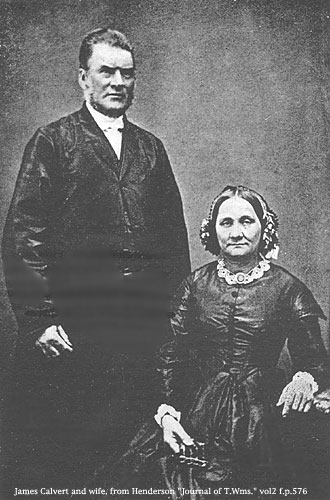
 James Calvert (Wood O'seas Missions p.62) [Click to see earlier picture of him with wife]
|
James Calvert (Wood O'seas Missions p.62) [Click to see earlier picture of him with wife] |
The Wesleyan missionary Rev. James Calvert and his wife conducted their ministry in Fiji for seventeen years between 1838-55, the first ten years at Lakeba, then again 1861-65. Their lives were frequently in peril, and it was in large part due to Calvert that Cakobau converted to Christianity, a turning point in Fijian affairs. The drawings that were transformed into the six wood engravings that illustrate his book Fiji and the Fijians: v.2 Mission History are unattributed, but some of them may have been done by the wife of his colleague Rev.Richard Burdsall Lyth M.R.C.S., who was a friend of Mrs Calvert and a gifted artist, or they may have been by Thomas Williams, also a talented artist in his own right. However, the picture of the temple Na Vata ni Tawake is very superior in quality to the others, and may have been, like the Cakobau portrait in the Williams volume, one of the drawings done by the artist James Glenn Wilson of the HMS Herald on one of its three survey visits to Fiji (1854, 1856, 1857), or alternately by Lieut. Conway Shipley, artist on HMS Calypso c.1848, who published drawings done on Bau in his book Sketches in the Pacific Further reading - G.C. Henderson Fiji and the Fijians (1931, Sydney, Angus & Robertson) and H.Wood Overseas missions of the Australian Methodist Church. v.II, Fiji (1978, Melbourne , Aldersgate Press, p.45). |
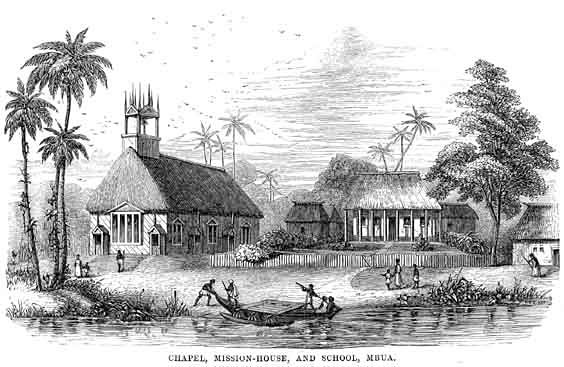 |
"Chapel, mission-house, and school, Mbua". [Frontispiece] |
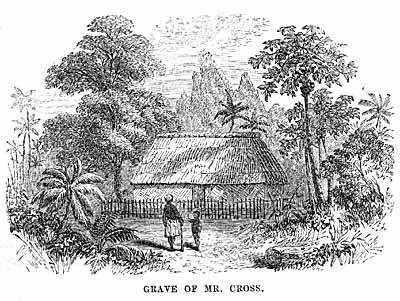 |
"Grave of Mr Cross" p.34 |
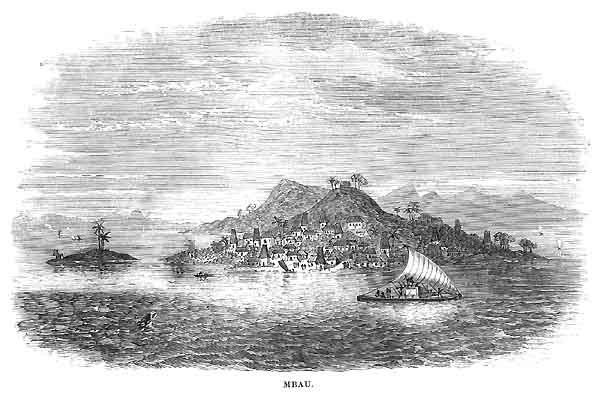 |
"Mbau" [the powerful chiefly island of Bau] facing p.232 |
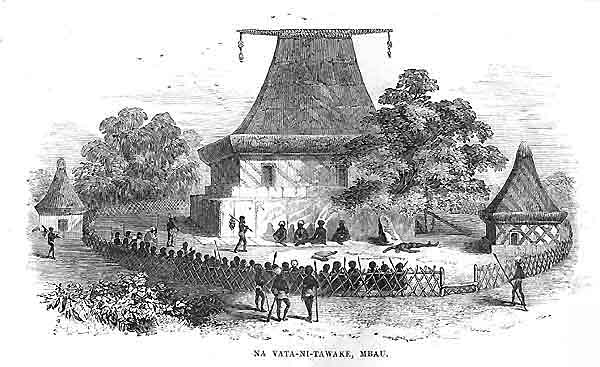 |
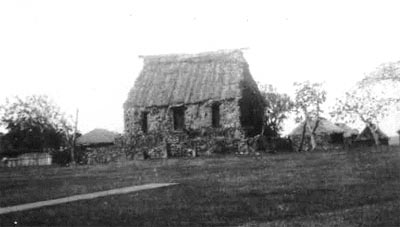
"Bure of Na Vata-ni-Tawake, Mbau" p.291. The housemound of this handsome temple (burekalou) still exists today (though the stone facing is largely gone), and a far smaller, relatively pedestrian structure sits on it bearing the same name (for a photo of the 1930s structure, click HERE). For a discussion of the likely authorship of this drawing, see the introductory notes above. The great killing-stone visible in the foreground became a baptismal font in the church. It was reportedly broken in the 1980s by (indigenous) Public Works Department workmen who found it difficult to move intact, and later clumsily cemented it back together. Such insensitivity to cultural heritage is, sadly, all too common in Fiji today, despite claims of a reverence for tradition, |
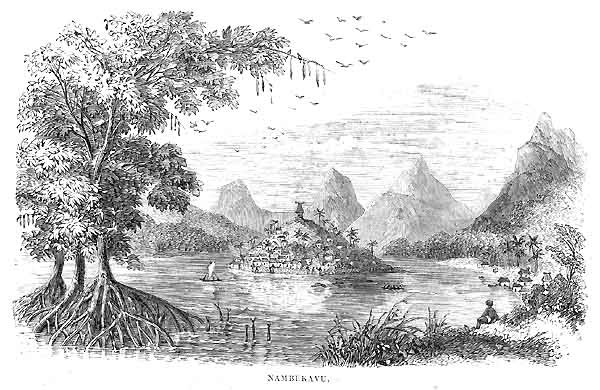 |
"Nambekavu" [Nabekavu] p.360 |
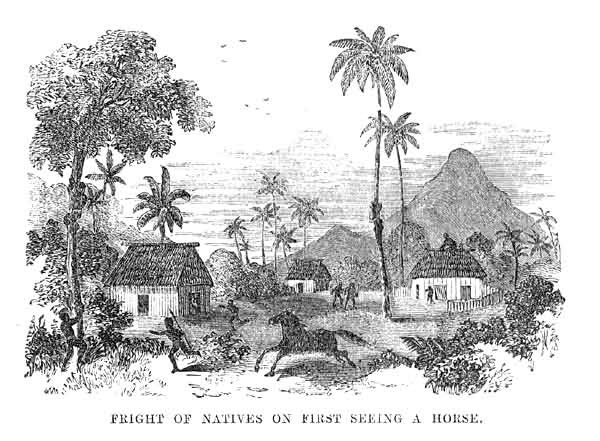 |
"Fright of natives on first seeing a horse" p.407 |